

The Last True Frontier: Why the World is Rushing to Mongolia to Rediscover Humanity

In an era of hyper-globalization, the world is rapidly shrinking into a single, uniform identity. Walk down the main avenue of almost any major global capital today, and the view is strikingly similar: the same smartphone screens, the same corporate coffee chains, and the same architectural designs. Across the globe, ancient heritages, distinct regional customs, and generational wisdom are quietly eroding under the weight of the internet and digital monoculture.
But there is a massive, silent rebellion happening among global travelers. A new wave of explorers is turning away from predictable luxury resorts and crowded historical themes parks. Instead, they are heading to Mongolia—the world’s newest hot destination.
Mongolia has achieved a historical miracle: it is successfully evolving with 21st-century technology while fiercely preserving its thousand-year-old identity. Step outside the capital city of Ulaanbaatar, and you enter a living, breathing antiquity where lifestyle, customs, and landscapes remain completely unchanged from the days of the Great Mongol Empire. Here is why the modern world is looking to Mongolia to remember what it means to be truly connected to the Earth.
1. The Symphony of Living with the Land and Animals
Where modern industrial civilizations view nature as something to be conquered, paved, or extracted, Mongolian nomadic culture treats the Earth as a living partner. For thousands of years, the nomadic lifestyle has been dictated by a deep, spiritual co-existence with their animals and the seasonal rhythms of the steppe.
The Sacred Law of the Five Snouts
A nomad’s life revolves around the Five Snouts (Tavan Khushuu Mal): horses, sheep, goats, camels, and cattle/yaks. Every single custom associated with these animals is rooted in absolute respect and zero waste:
The Calling of the Mother: If a sheep or camel rejects its newborn offspring, nomads do not use mechanical intervention. Instead, they perform the "Hoos" ritual, playing the horsehead fiddle (Morin Khuur) and singing traditional melodies until the mother animal is moved to tears and accepts her baby.
The No-Waste Philosophy: When an animal is slaughtered for sustenance, a strict shamanic and respectful process ensures the animal does not suffer. Every single part—from the hide to the intestines—is utilized. Bones are kept to create intricate traditional games, ensuring nothing is casually discarded.
2. The Architecture of Freedom: The Mobile Ger
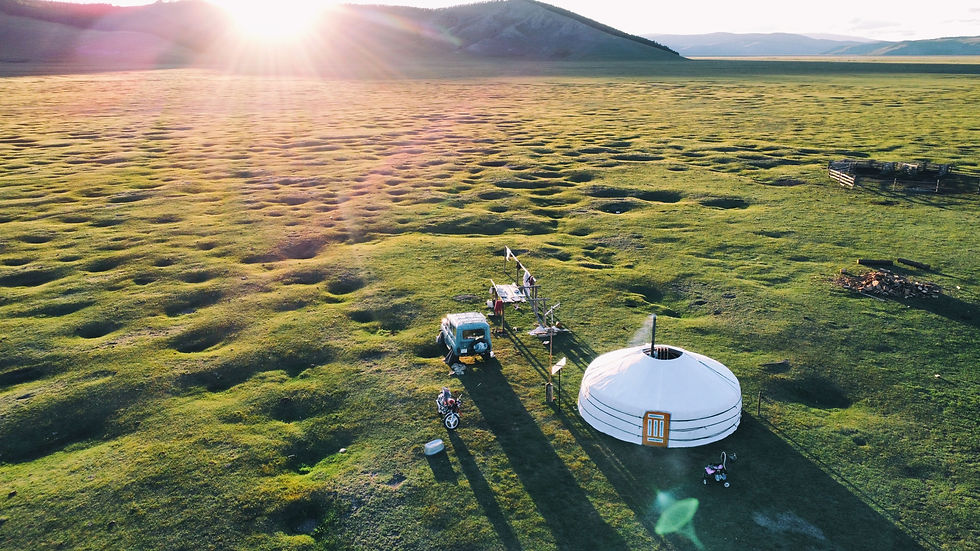
The traditional Mongolian Ger (yurt) is a masterpiece of sustainable, nomadic engineering that has remained unchanged for millennia. It is not just a house; it is a portable universe deeply tied to cosmological customs.
Living with the Sun: The circular structure has a central roof opening (Toono). The wooden slats radiating from the center act as a sundial. By watching where the sunbeams strike the lattice walls (Khana), a nomad knows the precise time of day without ever looking at a clock.

The Threshold Rule: When entering a ger, stepping on the wooden threshold (Bosogo) is considered a severe insult to the host, historically symbolizing stepping on the neck of the house master.
The Ultimate Zero-Footprint Home: Constructed entirely of felt, leather, and wood, a ger can be collapsed and packed onto the backs of camels or trucks within two hours, leaving absolutely zero scar or footprint on the pastureland.
3. The Spirit of the Steppe: The Horse and Endless Endurance
In Mongolia, a horse is not a pet or mere livestock—it is a soulmate. Children learn to ride before they can walk, and the deep bond between human and horse defines the nation's extreme endurance.
The Sacred Tool: A horse's head must never be touched with disrespect. When a beloved horse passes away, its skull is traditionally placed on top of a sacred mountain Ovoo (stone cairn) facing the sky. Nomads never lasso a horse around the neck tightly; instead, they use an Uurga—a long wooden pole with a leather loop, showing immense physical finesse.
Extreme Endurance: Surviving winters that plummet to -40°C (-40°F) and summers that scorch, both the Mongolian people and their semi-wild horses possess unparalleled physiological resilience. They drink Airag (fermented mare’s milk), a nutrient-rich, probiotic-heavy beverage that provides immense energy and sustenance across vast, waterless distances.
4. Ancient Shamanism, Sacred Mountains, and Communication
While the rest of the world replaced its indigenous spiritualities with institutionalized religions, Mongolia kept its primordial connection to the cosmos wide open.
Tengerism & Shamanism: Nomads believe the Munkh Tenger (Eternal Blue Sky) and the Earth Spirits (Gazar Savyg) govern all life. Shamanic practitioners enter deep trances to communicate with ancestors, reading the cracks on burnt horse shoulder blades to predict weather patterns and heal ailments.
The Mountain Ovoos: At the crest of mountain passes stands an Ovoo—a sacred pyramid of stones, branches, and blue silk scarves (Khadag). Travelers must circle the Ovoo three times clockwise and add a stone to thank the mountain spirits for safe passage.
The Custom of "Utsas" (The Steppe Telegraph): Long before the internet, nomads possessed a flawless communication network. Whenever a traveler approaches a ger, they yell "Nokhoigoo Khorio!" (Hold your dog!). Upon entering, they engage in a formal, beautifully slow greeting ritual, exchanging snuff bottles (Khörog) and passing vital news across hundreds of miles of open prairie within days.
5. Mind Games and Ancient Military Tactics
The intellectual and strategic brilliance of Mongolia is preserved perfectly in its traditional entertainment and historical legacy.
Intellectual Toys (Ankle Bones): Mongolian children do not grow up relying entirely on digital tablets. They play Shagai—games using the cleaned ankle bones of sheep or goats. Each side of the bone represents a different animal (horse, camel, sheep, goat). Games like Shagai Kharvaa (ankle bone shooting) train incredible hand-eye coordination and tactical calculating minds.
Flawless War Tactics: The legendary cavalry strategies that conquered the globe are still visible in how herders manage massive livestock roundups today. Tactics like the Mangudai (feigned retreat to draw enemies out) and the Arrow Storm relied on riders controlling horses using only their legs, leaving both hands free to shoot composite bows with deadly accuracy.
6. Language and the Code of Steppe Hospitality
The Mongolian language contains beautiful, untranslatable words that perfectly mirror their nomadic world. They have over 20 distinct words to describe the specific coat color or pattern of a horse, and multiple terms for different types of grass.
Unconditional Hospitality: Because the environment is so extreme, hospitality is a survival law. A traveler can approach any isolated ger in the middle of the night, and the family will automatically open the door, stoke the fire, pour hot milk tea (Suutei Tsai), and offer a bed without asking for a single coin or asking who they are. To refuse a traveler is considered a sin against the sky.
The Modern Synthesis: Evolving, Not Erasing
What makes Mongolia truly fascinating to modern travelers is that it is not a museum frozen in time. It is a dynamic, modern nation.
Today, a nomad might use a solar panel attached to their ger to charge a smartphone, check satellite weather apps, or power a satellite television. They might use a motorcycle to scout distant valleys for lost cattle. Yet, when they enter the ger, they still bow to the elders, sit on the correct side of the hearth, sing the ancient long songs (Urtiin Duu), and live by the exact same moral code their ancestors practiced under Chinggis Khaan.
As the rest of the world turns into a uniform digital landscape, Mongolia remains the ultimate destination for those seeking an authentic, raw, and deeply spiritual human experience. It is a place where you can look up at a completely unpolluted night sky and realize that some things are too beautiful for globalization to ever erase.


Comments